
The hawza of Najaf — the Shia seminary system based in the Iraqi city of Najaf — has served as a major center of Shia scholarship for over a millennium. The hawza's methods, structure, and intellectual traditions have shaped Shia thought across centuries. This article analyzes the system's structure and significance.
The historical foundations
Najaf's significance as a center of Shia scholarship has roots in the location of the shrine of Ali ibn Abi Talib, the first Imam in Twelver tradition. The shrine has attracted Shia visitors and residents since shortly after Ali's death.
The formal seminary system in Najaf developed gradually. Major foundational figures include Sheikh al-Tusi (d. 1067), who relocated from Baghdad to Najaf and established educational institutions that became foundations for subsequent development. The system continued to develop across subsequent centuries, periodically affected by political and security conditions in Iraq.
The hawza of Najaf reached particular prominence at various periods, including the late 19th and early 20th centuries when major scholars based in Najaf produced foundational works that continue to shape contemporary Shia thought.
The educational structure
Hawza education is structured around several distinct stages:
Muqaddamat (preliminaries) — initial study covering Arabic grammar, basic logic, fundamentals of religious knowledge. Typically lasts 2-4 years.
Sutuh (elementary advanced texts) — study of standard texts in Arabic, jurisprudence, principles of jurisprudence, theology, and related subjects. Typically lasts 4-7 years.
Bahth al-kharij (external research) — advanced study under specific senior scholars, focused on independent research and engagement with primary sources rather than standard textbooks. This stage continues for many years and is where the capacity for ijtihad develops.
The progression is not strictly chronological. Students may spend additional time at any stage, may study multiple subjects in parallel, and may transition between stages based on demonstrated mastery rather than fixed schedules.
The teaching methods
Hawza teaching methods have distinctive characteristics:
Text-centered study. Most subjects are studied through engagement with classical texts. Students learn to read, interpret, and engage with the textual tradition.
Dialectical engagement. Discussion, questioning, and debate are central methods. Students are expected to challenge teachers' positions, raise objections, and develop independent positions.
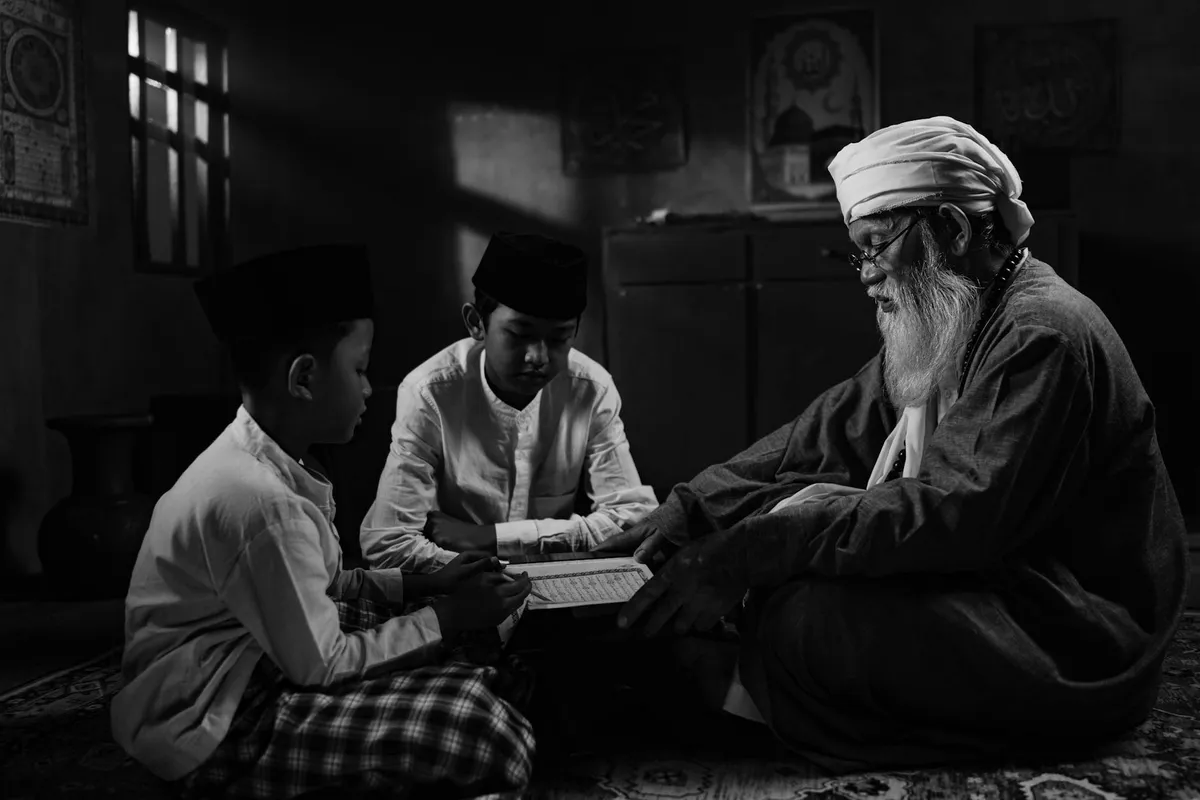
Master-disciple relationships. Senior scholars develop relationships with specific students who study under them across years. The relationship is more than instruction; it includes character formation and intellectual mentoring.
Public lectures. Major scholars give public lectures attended by students and other scholars. The lectures are often recorded and circulated; major lecture series have shaped Shia scholarship across decades.
Independent reading and research. Students are expected to do substantial independent reading and research alongside formal classes. The expectation of self-directed engagement is part of how scholars are formed.
The contemporary structure
The contemporary hawza of Najaf operates with several major institutional elements:
- Senior marja' who lead the scholarly community and represent the hawza in various contexts
- Established educational institutions that house formal classes and student housing
- Publishing operations that produce scholarly works, primary source editions, and educational materials
- Charitable and social institutions that fund the hawza's educational work and provide services to surrounding communities
- Networks of representatives in other locations who maintain connections between the hawza and broader Shia communities
The total number of students in Najaf hawza varies but typically numbers in the thousands to tens of thousands. Students come from across the Shia world; the diversity of student backgrounds is itself part of how Najaf functions as an international center.
The relationship to Qom
The other major contemporary Shia seminary center is Qom in Iran, which has grown substantially since the establishment of the Islamic Republic in 1979. The relationship between Najaf and Qom involves both cooperation and distinction.
Differences include:
- Political context. Qom operates within the Iranian political system; Najaf operates under different political circumstances in Iraq.
- Methodological tendencies. Some scholars perceive different methodological emphases in the two centers; the perceived differences are real but often overstated.
- Network relationships. Different scholars maintain different connections; the practical effect on followers is the choice of which scholarly tradition to engage with.
Both centers train scholars who become marja'; both publish substantial scholarship; both provide guidance to broad Shia communities. The two centers should be understood as related complementary centers rather than as opposed institutions.
The challenges across recent decades
The Najaf hawza has faced substantial challenges across recent decades:
Saddam Hussein's regime (1979-2003) was hostile to Shia institutions. Many scholars were imprisoned, killed, or forced into exile. The hawza operated under severe constraints during this period.
Post-2003 Iraq brought substantial changes. The hawza was able to operate more openly; new generations of scholars began to develop. Security challenges and political instability continued to affect operations.
Contemporary challenges include economic constraints, generational succession of senior scholars, engagement with modern intellectual and technological contexts, and the broader political and security situation in Iraq and the region.
Despite these challenges, the hawza has continued to function and produce scholarship. The institutional resilience reflects the depth of the scholarly tradition and the commitment of scholars and supporting communities.
Significance for contemporary Shia thought
The Najaf hawza's significance for contemporary Shia thought is substantial:
- Intellectual production. Major scholars based in Najaf continue to produce substantial scholarship on jurisprudence, theology, and related subjects.
- Religious authority. The current senior marja' in Najaf is among the most-followed religious authorities in contemporary Shia Islam.
- Educational training. Scholars trained in Najaf serve communities across the Shia world.
- Counterweight to political religion. The Najaf tradition has historically maintained certain distance from direct political authority; this position offers an alternative to models that integrate religious and political authority more closely.
For readers studying contemporary Shia Islam
For readers studying contemporary Shia Islam, the Najaf hawza is among the essential institutions to understand. The hawza's history, methods, and contemporary operations are extensively documented in scholarly literature.
Key resources include works by scholars who have studied the hawza directly (Walbridge, Litvak, Cole, others) plus translations of works by major Najaf scholars across centuries.
The closing observation
The hawza of Najaf is one of the major institutions of contemporary Shia Islam. Its history extends across more than a millennium; its current operations continue traditions established across that long period.
For serious engagement with Shia thought, understanding how scholarship is produced and transmitted in the hawza system is essential. The institutions are real and consequential; they shape what Shia Islam is and what it will become.
Source notes
Analysis draws on Meir Litvak, Shi'i Scholars of Nineteenth-Century Iraq (Cambridge, 1998); Yitzhak Nakash, The Shi'is of Iraq (Princeton, 2003); and Linda Walbridge, The Most Learned of the Shi'a (Oxford, 2001), plus contemporary research published in Shia studies journals.