
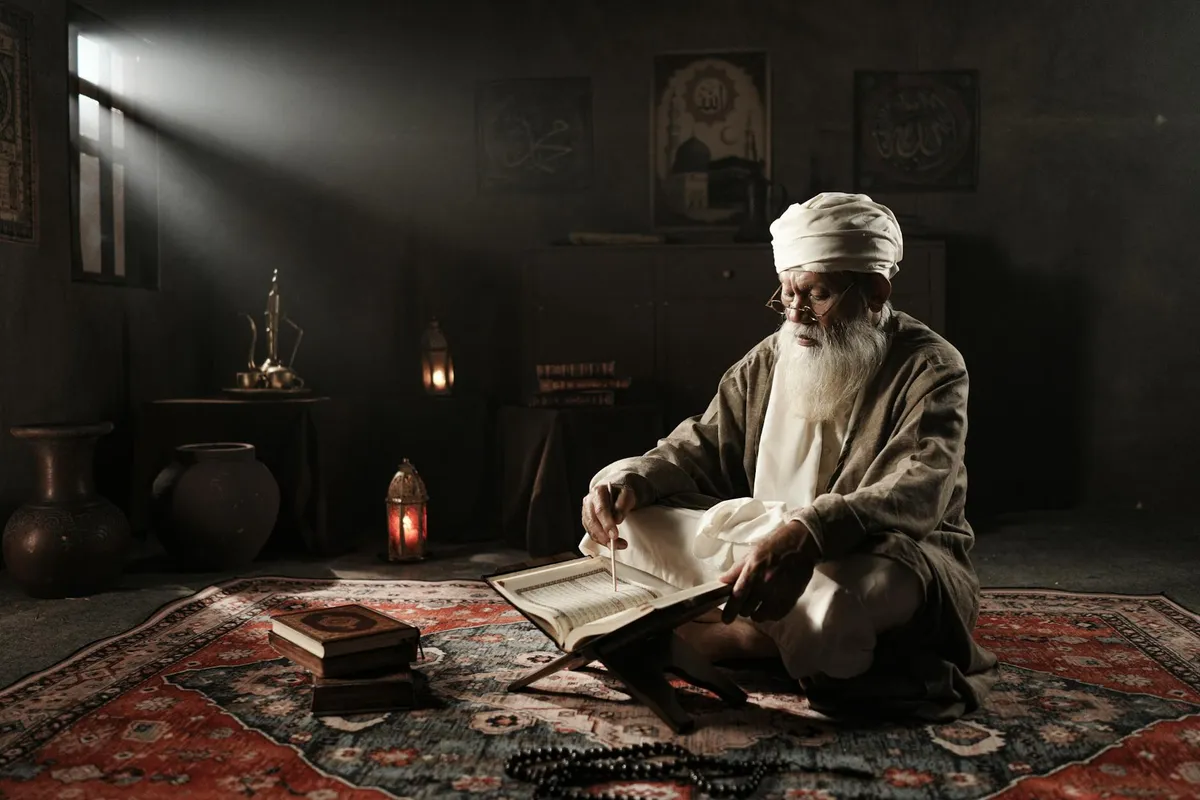
The marja' al-taqlid system organizes religious authority in contemporary Twelver Shia Islam. The system designates qualified senior scholars as sources of religious guidance for ordinary believers, who follow their rulings on matters of religious practice. Understanding the marja' system is essential for understanding contemporary Shia religious life.
The basic structure
In Twelver Shia practice, religious questions requiring expert interpretation are addressed by senior scholars trained in Shia jurisprudence. Believers select a qualified scholar (marja') whose rulings they follow on matters of religious practice. The selection of which marja' to follow is itself a religious choice with significant implications.
The qualifications for becoming marja' are substantial:
- Extended seminary training typically lasting 20+ years
- Mastery of Arabic, Quranic studies, hadith, jurisprudential methodology, and related disciplines
- Reaching the level of ijtihad (capacity for independent legal reasoning) recognized by other senior scholars
- Recognition by other established marja' through processes that vary but generally require demonstrated scholarly competence
- Personal qualities including piety, just character, and commitment to scholarly work
The qualification process is informal in the sense that no single institution certifies marja'. Recognition emerges through scholarly consensus and through the practice of believers following specific scholars.
The major centers of training
Marja' training takes place in established seminary cities. The most-significant include:
- Najaf, Iraq — the historical center of Shia scholarship; produced many of the most-significant marja' across centuries.
- Qom, Iran — the major contemporary center, particularly since the establishment of the Islamic Republic of Iran in 1979.
- Mashhad, Iran — significant center associated with the shrine of the eighth Imam, Imam Reza.
- Karbala, Iraq — historically significant center.
- Lebanon, Bahrain, and other regional centers — secondary centers with their own scholarly traditions.
Different centers have developed somewhat different scholarly traditions, methodological emphases, and contemporary positions. The choice of center for training affects the scholarly orientation of resulting marja'.
The current major marja'
At any given time, several scholars hold marja' status that's recognized by substantial communities of followers. The current major marja' (as of recent years) include figures based primarily in Najaf and Qom. The specific names and their relative followings shift as scholars age and new generations emerge.
The selection of which marja' to follow is influenced by:
- Family tradition and community affiliation
- Geographic and linguistic accessibility
- Scholarly reputation and methodological orientation
- Personal connection through teaching or other relationships
- Specific positions on contemporary religious questions
Most Shia believers follow established marja' based on these factors. The choice typically remains stable across years; switching marja' is uncommon though not prohibited.
How the system operates
The marja' system operates through several specific mechanisms:
Risala amaliyya — practical guides published by major marja' that contain rulings on common religious questions. These are extensive (often hundreds or thousands of rulings) and serve as the primary reference for followers on questions of religious practice.
Direct fatwas — responses to specific questions submitted by followers. Major marja' offices receive thousands of questions and provide individual responses on questions not covered in the published guides.
Networks of representatives — appointed scholars and clerics in various locations who provide guidance to local communities, collect religious dues (khums), and represent the marja' in various contexts.
Educational institutions — seminaries and educational programs that train the next generation of scholars under the marja's guidance and methodological framework.
Charitable and social functions — substantial financial flows through religious dues fund educational, charitable, and social institutions managed under marja' guidance.
The scholarly disagreement that's normal
Different marja' often hold different positions on specific religious questions. Scholarly disagreement is normal and expected. Followers receive guidance from their specific marja'; the disagreements between marja' don't typically destabilize the system because each follower has clear religious authority through their own marja'.
The disagreements concern:
- Specific legal questions (what's permitted in particular circumstances)
- Methodological approaches to deriving rulings
- Engagement with contemporary issues (medical ethics, financial practices, technology, etc.)
- Political questions in jurisdictions with active religious-political life
The pluralism within the system is part of how it functions. Different marja' provide different paths through religious questions; followers select among them through the choice of which marja' to follow.
The political dimension
The marja' system has political dimensions that vary by context. In Iran since 1979, the relationship between the marja' system and the Islamic Republic has been a major question. Some marja' have aligned closely with the political system; others have maintained more-distance from it. The disagreements about the proper relationship between religious authority and political authority remain active.
In Iraq, the marja' system based primarily in Najaf has historically maintained a more-quietest position with respect to political authority. The current senior marja' in Najaf has held positions on Iraqi political questions but with characteristic restraint.
In Lebanon, Bahrain, and other Shia communities outside Iran, the relationship between marja' and local politics varies by context. The marja' system itself is religious; its political implications differ by jurisdiction.
Contemporary developments
Several developments have shaped the contemporary marja' system:
- The challenges of modernity. Marja' increasingly need to address questions about technology, financial systems, medical practices, and other modern issues that classical jurisprudence didn't directly address.
- Diaspora communities. Shia communities in Western countries and elsewhere outside traditional centers have created new contexts for the marja' system to operate in.
- Digital communication. Online publications, websites, and direct digital communication between marja' offices and followers have transformed how the system operates.
- Generational succession. The transition from one generation of senior marja' to the next is an ongoing process with significant implications for the system's future.
For ordinary believers
For ordinary Shia believers, the marja' system functions as the source of religious guidance for daily practice. Selecting a marja', studying their guide, consulting their representatives for specific questions, and contributing religious dues to their institutions are normal religious activities.
The system's ongoing function depends on the credibility of the marja' themselves and the educational institutions that train them. The system has demonstrated substantial resilience across centuries; contemporary developments are extending it into new contexts while maintaining its core structure.
The closing observation
The marja' system is one of the most-distinctive features of contemporary Twelver Shia practice. Understanding it requires engagement with both the formal structure (qualifications, training, recognition) and the lived practice (how believers actually engage with religious authority in their lives).
For readers studying contemporary Shia Islam, the marja' system is among the most-important contemporary institutions. It connects the classical tradition to ongoing religious life in ways that are visible across Shia communities globally.
Source notes
Analysis draws on the contemporary scholarship including Linda Walbridge, ed., The Most Learned of the Shi'a (Oxford, 2001); Robert Gleave's work on Shia jurisprudence; and aggregated current research in Shia studies journals.