
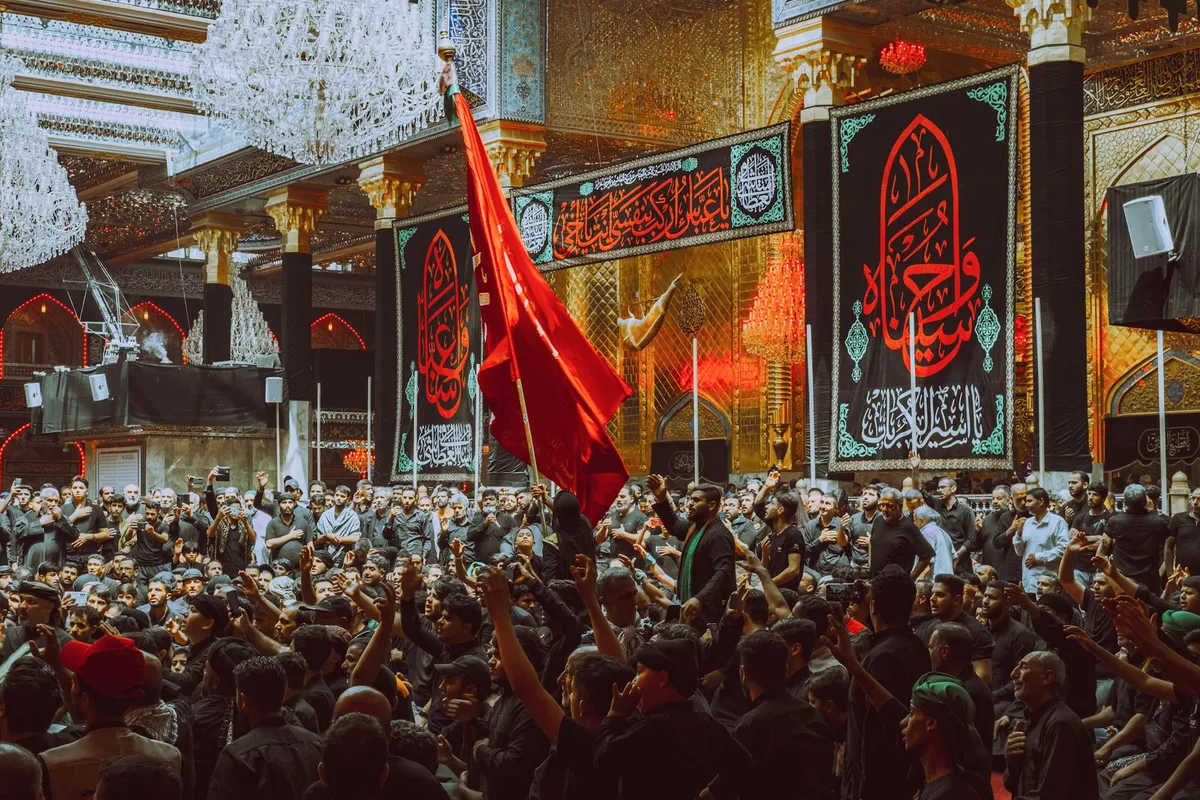
The annual commemoration of the events at Karbala in 680 CE — when Hussein ibn Ali, grandson of the Prophet Muhammad, was killed along with his family and companions — is among the most-distinctive practices of Shia devotional life. The commemoration centers on Ashura (the 10th of the month of Muharram) and Arba'in (the 40th day after Ashura), with substantial ritual practice across the Shia world. This article analyzes the practices, their development, and their religious significance.
The historical events
The events commemorated occurred in 680 CE (61 AH) at Karbala in present-day Iraq. Hussein, the grandson of the Prophet Muhammad and son of Ali ibn Abi Talib, refused to acknowledge the legitimacy of the Umayyad caliph Yazid I. Hussein traveled with his family and a small group of companions toward Kufa, where supporters had invited him to lead opposition to Umayyad rule.
The party was intercepted at Karbala by a much larger Umayyad force. Negotiations failed. On the 10th of Muharram (Ashura), the Umayyad force attacked. Hussein and most of his male companions were killed; women and children were taken captive.
The historical events are documented in early Islamic sources with substantial detail. The events became the central narrative for Shia tradition's interpretation of suffering, sacrifice, and resistance to unjust authority.
The development of commemoration
Commemoration of the Karbala events began relatively early in Shia tradition. Historical sources indicate ritual mourning practices in the immediate aftermath; these practices developed and elaborated across subsequent centuries.
Major developments in the commemoration tradition:
Early period (1st-3rd Islamic centuries). Initial mourning practices, often conducted privately or in restricted contexts due to political constraints under various dynasties.
Buyid period (10th-11th centuries). Public commemoration emerged with greater visibility under Shia political authority. The practice of public processions and gatherings began to take recognizable forms.
Safavid period (16th-18th centuries). Substantial elaboration of commemoration practices in Iran. Distinct ritual forms (ta'ziyah dramatic performances, particular procession styles, specific elegiac literature) developed during this period.
Modern period. Continued elaboration with regional variations across the Shia world. The current forms reflect long historical development with specific regional and cultural inflections.
The contemporary practices
Contemporary commemoration of Karbala includes several distinct ritual elements:
Majalis — gatherings during the first ten days of Muharram (and continuing through Arba'in) where attendees listen to recitations of the Karbala narrative, sermons connecting the events to contemporary religious life, and elegiac poetry.
Processions — public processions on Ashura and other significant days, often involving ritual mourning practices including chest-beating (matam) and other expressions of grief. Processions vary substantially by region in their specific forms.
Ta'ziyah — dramatic performances reenacting the Karbala events, particularly developed in Iranian tradition. The ta'ziyah tradition includes substantial poetic and theatrical elements.
Pilgrimage — pilgrimage to the shrine of Hussein in Karbala (and to other shrines associated with the Karbala events). The Arba'in pilgrimage, which culminates 40 days after Ashura, has become one of the largest annual religious gatherings globally, with millions of pilgrims walking to Karbala.
Hospitality — extensive provision of food, drink, and shelter to pilgrims and participants. The hospitality is itself considered religiously meritorious; communities along pilgrimage routes provide elaborate support to passing pilgrims.
Charitable giving — increased charitable activity associated with the commemoration period.
The religious significance
The commemoration carries substantial religious significance within Shia tradition:
Spiritual identification with Hussein's suffering. The mourning practices create religious experience of identification with Hussein's sacrifice. The experience is understood to draw the believer into closer relationship with the Imam and through him with God.
Moral and political teaching. The Karbala narrative teaches resistance to unjust authority, fidelity to truth despite consequences, and willingness to sacrifice for religious principles. Contemporary applications of these teachings vary across Shia communities.
Communal identity. The commemoration constitutes a major occasion for Shia community life. Annual participation reinforces community identity and connections.
Devotional intensity. The Muharram period concentrates religious activity in ways that other times of the religious year do not. The intensity is itself part of the religious experience.
Regional variations
Commemoration practices vary substantially across regions:
- Iran has highly-developed commemoration traditions including ta'ziyah performance and elaborate processions.
- Iraq centers commemoration on the Karbala shrine and the Arba'in pilgrimage.
- South Asia (Pakistan, India, Bangladesh) has distinctive commemoration traditions including specific procession forms and ritual practices.
- Lebanon has commemoration practices shaped by its specific historical and political context.
- Bahrain and the Gulf have commemoration traditions with their own regional characteristics.
- Diaspora communities have adapted commemoration practices to their local contexts while maintaining core elements.
The variations reflect the long history of Shia communities in different regions and the cultural contexts that have shaped local religious practice.
Internal debates about commemoration practices
Specific commemoration practices have been subjects of internal Shia debate. Practices involving severe self-injury (specific forms of matam involving cutting) have been criticized by some senior scholars as departing from religious moderation. Other practices have been defended as authentic expressions of devotion.
These debates are ongoing within Shia communities. Different marja' have different positions on specific practices; followers receive guidance from their own marja' on which practices are appropriate.
The internal discussions reflect serious engagement with the religious and ethical dimensions of commemoration. They are not external criticisms of Shia practice but internal debates about how the tradition should be expressed.
The Arba'in pilgrimage
The Arba'in pilgrimage to Karbala has become particularly notable in recent years. The pilgrimage commemorates the 40th day after Ashura, traditionally marked by family members of Hussein arriving at Karbala after captivity. Contemporary pilgrims walk to Karbala from various points across Iraq and from other countries; the largest concentrations come from Iran, Iraq, and Lebanon, with substantial numbers from other Shia communities.
Recent estimates have placed the pilgrimage at 15-20 million participants, making it among the largest annual religious gatherings globally. The hospitality networks supporting the pilgrimage are extensive; communities along the routes provide food, water, shelter, and other support.
The pilgrimage has political and security dimensions in addition to religious ones, given the contemporary context in Iraq and the broader region.
The closing observation
The annual commemoration of Karbala is among the most-significant practices of Shia devotional life. The commemoration carries deep religious meaning, substantial community function, and ongoing development across centuries of practice.
For readers studying Shia religious life, engagement with Karbala commemoration is essential for understanding the lived religion of Shia communities. The historical events at Karbala in 680 CE continue to shape Shia identity and practice in ways that no other historical event quite matches.
Source notes
Analysis draws on the published scholarship including Mahmoud Ayoub, Redemptive Suffering in Islam (Mouton, 1978); David Pinault, The Shiites: Ritual and Popular Piety in a Muslim Community (St. Martin's, 1992); and recent ethnographic and historical work on contemporary Shia devotional practice.